

Praying With the Psalms When You Don’t Know What to Say
Begin with Psalm 13 or Psalm 23, read the whole passage, and leave room for an honest response in your own words.

In this story
When you don’t know what to say in prayer, try reading a whole psalm slowly and responding to one part of it in your own words. You can begin with a question, a request or a simple expression of thanks. There’s no need to make your response sound polished.
Some days you sit down to pray and find that your thoughts won’t settle. On others, you know exactly what’s troubling you but struggle to say it aloud. Reading Scripture can give you a place to begin without requiring you to invent every word.
Psalm 13 and Psalm 23 offer two different starting places. Read each as a whole before choosing a phrase. The reflections below are suggestions for prayer, with room for your own circumstances and your church’s practice.
Begin by listening to the whole psalm
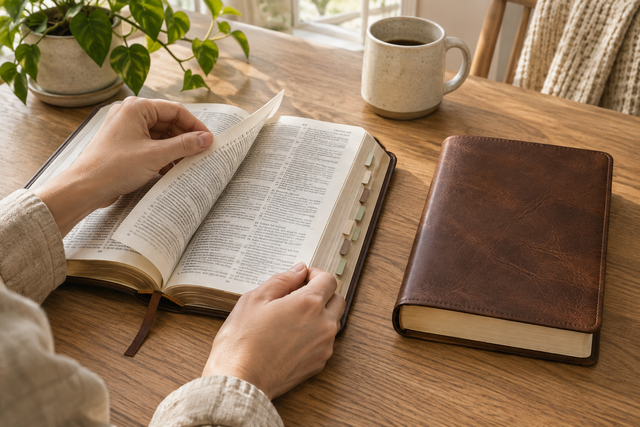
Open the passage in the translation you usually read. If it helps you pay attention, read it aloud. Notice who is speaking, what they are asking and how the psalm develops from beginning to end.
Give unfamiliar wording a little time. You can write down a question and look into it later, or discuss it with someone you trust at church. You don’t have to turn every sentence into a personal message or find an immediate connection to your day.
Then choose one part to return to. You may find that it expresses something you’ve been carrying, or that it gives you a question you want to bring to God.
Psalm 13: a place for an honest question
“How long wilt thou forget me, O Lord?”
Psalm 13:1 · King James Version
Read all six verses of Psalm 13. It opens with repeated questions about sorrow and God’s apparent absence. The speaker asks God to hear him, then ends by expressing trust and praise.
As a devotional reflection, this can make room for prayer that includes an unresolved question. You can acknowledge what is painful while asking God for help. The movement of the psalm doesn’t give you a deadline for feeling better.
What am I finding hard to say?
You could begin: “God, I’ve been waiting for ______. I don’t understand ______. Please help me bring this honestly to you.”
Use your own words, leave a pause, or stop after the first sentence. This prompt is a suggestion from Shepherd’s Shelf, separate from the biblical text.
Psalm 23: a place to ask for guidance
“The Lord is my shepherd; I shall not want.”
Psalm 23:1 · King James Version
Read all six verses of Psalm 23. Its language of rest and guidance sits alongside a valley, enemies and danger. The passage’s comfort includes God’s presence in difficulty.
You might respond by asking for guidance in one decision or for help facing a particular day. If you come to this psalm tired or worried, you don’t need to force yourself into a peaceful mood before praying.
One possible response is: “God, I need guidance about ______. Help me take the next step with care.” It can be a short request, followed by a little quiet.
A simple way to respond
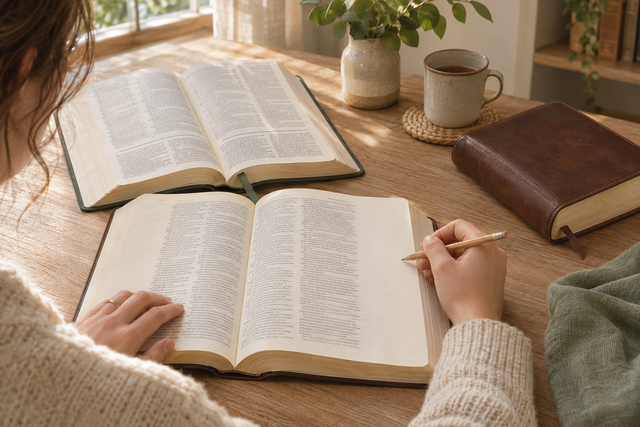
Keep your Bible open so you can look back at what you’ve read. If writing helps, leave a few lines in a notebook for each of these questions.
- NoticeStay with the passage
- What does this psalm actually say? Write down a phrase or an honest question about it before moving to your own situation.
- BringName one thing
- What would you like to bring to God today? It may be a concern, gratitude, a confession or a request for someone else.
- RespondUse your own words
- Write or speak a short prayer. You can return to the passage afterward, leave a quiet pause or close your notebook for now.
You may prefer to do only one of these. Keep it manageable enough that you can give the passage your attention. A page full of writing isn’t required.
When the words still feel far away
You might read the psalm again without writing anything. Or ask a friend, pastor or someone in your church community to pray with you. You can say plainly, “I’m finding prayer difficult today. Would you sit with me for a moment?”
It’s also fine to return to the same passage on another day. You don’t need a fresh method every time you open your Bible. Familiar words can be worth reading carefully again.
If something in the passage confuses or troubles you, keep that question. Bring it to a conversation where there’s time to read the wider context together.
Leave a little room to return
If you’ve written a prayer, you could add the date and the psalm reference. Later, you may want to revisit the question, add a note or pray for the same person again.
For a place to write, our free printable collection includes a prayer journal. It’s optional; a notebook or a few quiet minutes with the passage can serve you too.
Explore the free prayer journal and Bible resources
Scripture: Psalm 13 and Psalm 23, King James Version (public domain). Passage summaries and devotional reflections are distinguished from quotations. Prayer examples and reflection prompts are original suggestions from Shepherd’s Shelf. The free resources are delivered by email; no purchase is required.
Make it personal.
Find their translation, their style, and a meaningful personal touch.